Algorithms of Power
https://www.neme.org/projects/algorithms-of-power
In times of geo-political and cultural crisis Algorithms of Power investigates and contextualises the potential of critical art practices, and explores the role of culture in times of erasure. Within this scope Algorithms of Power gains a vital agency and outreach as it examines the politics of space, and human rights.
Algorithms of Power will act as an introduction to a 2 to 3 year research project by NeMe which aims to scrutinise multiple areas related to the weaponisation of consumer technologies. The project will address, critically investigate and radically re-imagine, through the eyes of artists, scholars, and relevant actors the far-reaching issues that are emerging, damaging our democracies, endangering our lives, and our fragile peace in our geographical region and beyond.
Over the last decade, whether in Palestine or Israel, Pakistan or Mumbai, Baghdad or Kabul, Rwanda or the Sudan, the United States, Spain, or Great Britain, we have witnessed a vicious cycle in which terrorism causes terror and the experience of terror seeds acts of terrorism. And yet, though the human emotions we all share—fear, grief, and loss—are so clearly part of this murderous equation, in delineating and defining this violence rarely does society consider the experience of terror that lies at the heart of terrorism.1
The militarisation of consumer technologies has a long and complex history, which relates to the ongoing narrative of technological progress and warfare. In the 20th and 21st century, as digital devices and consumer electronics proliferated, so too did the potential for their use in conflict scenarios. From the early innovations of radio communication to the recent rise of artificial intelligence (AI) and the Internet of Things (IoT), consumer technologies have been repurposed for military advantage, raising ethical questions and operational concerns. McLuhan recognised that we have to understand technologies as having dual-natures and discussed how in World War II, radio communication had become integral to military strategy, underscoring the dual-use nature of such technologies.2
Aeroplanes, for example, were invented for civilian aviation but by 1910 were adapted for military reconnaissance, and later as assault flying machines that fire bullets and release bombs. Cars were also invented for civilian use but soon were adapted by the military, starting with F.R. Simms’ Motor Scout which was built in 1899 as an armed vehicle,3 whilst in 1920 the first car bomb exploded in Wall Street, NY.4 Published in 1971, The Anarchist Cookbook5 contained instructions for the manufacture of explosives, rudimentary telecommunications phreaking devices and related weapons.
In recent years, we are witnessing an increase in the number of actors exploiting these tools. From hardware and software to social media intelligence and data scraping, these technologies —part of our everyday lives—are being repurposed in dangerous, potentially lethal ways. The Brexit vote and the 2016 Trump campaign6 demonstrated how algorithms could be manipulated to gather support through platforms like Facebook whereas Twitter, now X, was weaponised by western powers to instigate the Arab spring.
The digital revolution has intensified the phenomenon of weaponisation. Due to the advance of increasingly sophisticated consumer technologies, including social media, geo-location services, and mobile computing, military forces around the world have begun to adapt and employ these technologies in novel ways. At the same time, and as Tufekci argues, ‘networked’ movements have developed and act to create organised protests through “the reconfiguration of publics and movements through assimilation of digital technologies into their fabric.” This reconfiguration has allowed for a new take on what a movement is, and she makes a claim that with the new information era, organising has taken a new form.7
However, it wasn’t until the news of exploding pagers in Lebanon on September 17, 2024, that we have encountered a form of warfare which was particularly shocking,8 one where technologies embedded in our daily lives were being used as lethal weapons by state actors. The news came 3 months after the 21 June 2024 when the Associated Press reported that the Secretary-General of the United Nations António Guterres warned that “‘the perils of digital technologies are growing by the year’ and malicious activity in cyberspace is on the rise by governments, non-government actors and criminals.”9
His views extended the European Commission’s concerns of “the risks of four critical technologies, including semiconductors and artificial intelligence, being weaponised by countries not aligned with its values and will take measures next year to tackle the issue”10 but also views published in NATO’s website stating that “exponential technological progress, especially in the digital domain, is affecting all realms of life. Emerging mainly from the commercial sector, it has led to a democratisation of technologies that could also be weaponised. Technological developments are also generating new dilemmas about their use by the military.”11
Seminar
Vladan Joler: Anatomy of Power – Technologies of Empire
In this talk, Vladan Joler presents Calculating Empires: A Genealogy of Technology and Power Since 1500, a sweeping visual and conceptual investigation into how technological systems and imperial power have co-evolved over five centuries. By tracing axes of communication, computation, classification, and control—from the early print press and colonial navigation to modern AI, surveillance, and planetary infrastructure—the work reveals how contemporary digital systems are deeply rooted in historical practices of extraction, enclosure, and domination. The lecture invites participants to critically examine how our modern computational order reflects centuries of empire, and to explore how new imaginaries might be drawn by reconfiguring the relations between technology, society, and political power.

Ameera Kawash: Divided Futures: Pluralising AI and Reparative Technologies
This talk explores the role of artists, the Global South, and archival practices in shaping reparative and decolonial approaches to artificial intelligence. It considers how artistic and cultural interventions can contribute to reparative practices and archival justice that address the enduring legacies of colonial injustice across temporal, technological, and cultural horizons. Through selected examples, the talk highlights how such practices challenge and reconfigure dominant trajectories of AI development, defined by corporate monopolies, extractive data regimes, and constrained imaginaries of the future.
It also foregrounds low-resource languages, lightweight and sustainable computing, and artistic work emerging from marginalised groups, cultures, and archives as vital sites of innovation and resistance. AI’s evolution is framed along two axes: the struggle over technological imaginaries—who has the power to envision, construct, and wield them—and the capacity of artistic and Global South-orientated practices to intervene in the course of AI’s development. In light of the widening AI divide, driven by inequalities in terms of hardware access and infrastructure, the talk addresses AI as a site of contestation, foregrounding Indigenous, Global South, decolonial, and critical artistic perspectives.

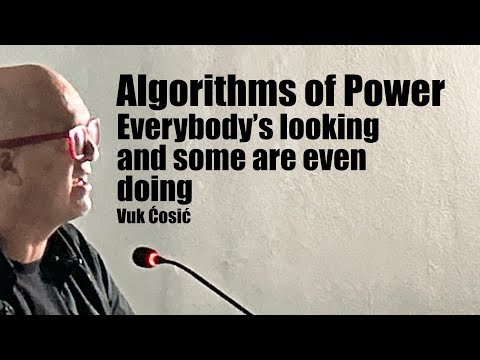
Vuk Ćosić: Everybody’s looking and some are even doing
A big war is coming. Everybody is buying weapons and peace protestors are globally called enemies of state. In the general militarisation craze we are getting clearer and clearer confirmation of our old paranoiac instincts about surveillance. Let’s talk about a hi-level map of that.
Credits
Curator: Yiannis Colakides
Coordinator: Helene Black
Participating artists: Ameera Kawash, Vuk Ćosić, Vladan Joler.
Programme
Opening: 31 October 2025, 17:00-21:00; 1-2 November 2025, 11:00-20:00.
Seminar: 3 November 2025, 19:00.
Exhibition Duration: 31 October – 28 November 2025.
Exhibition Opening days/times: Tuesday-Friday, 17:30-20:30.
Notes
- Karin Lofthus Carrington, Susan Griffin, eds. Transforming Terror: Remembering the Soul of the World. University of California Press, 2011
- Marshal McLuhan. Understanding Media: The Extensions of Man. McGraw-Hill., 1964.
- United Kingdom (1899) Scout Vehicle – 1 Built. Tanks Encyclopaedia .
- Karin Lofthus Carrington, Susan Griffin (Eds). Transforming Terror: Remembering the Soul of the World. University of California Press, 2011
- William Powell. The Anarchist Cookbook. Lyle Stuart, 1971.
- The Guardian. The Cambridge Analytica Files .
- Seynep Tufekci. Twitter and Tear Gas: The Power and Fragility of Networked Protest. Yale University Press, 2017.
- Dan Sabbagh. “Hezbollah pager explosions: questions over strategy behind unprecedented attack .” The Guardian, 17 Sep 2024.
- Edith M. Lederer. UN chief warns of perils of ‘weaponising digital technologies’ and malicious activity in cyberspace. , Associated Press, 21 June 2024
- Foo Yun Chee. “EU to assess risks of critical technologies being weaponised. ,” Reuters, 3 October 2023.
- Dr Antonio Missiroli. “Game of drones? How new technologies affect deterrence, defence and security. ,” NATO, 5 May 2020.
Funding
This project has been partially funded by the Cyprus Deputy Ministry of Culture. This communication reflects the views only of the author, and the Cyprus Deputy Ministry cannot be held responsible for any use which may be made of the information contained therein.