Our insurrection will not be televised
https://www.neme.org/texts/our-insurrection-will-not-be-televised
The precarity of the cultural sector in Cyprus
On 18-19 April 2026, NeMe has organised the COST funded Training School “Decentralised networks of care” which focused on the “numerous challenges [faced by NGOs], including funding constraints, competition for resources, and changing audience demographics, and how cultural NGO workers are considered in many countries as “hobbyists with their work not sufficiently recognised as a vital part of the economy and societal health.
” On May 25, and June 10 2026, I delivered variations of a talk outlining the activism we have been doing since 2020, and the theory that informs it. The first was for the COST funded Training School, “Subversive, Investigative, and Open Source Practices” at the University of Galway which was co-organised by the University of Galway, Sheffield Hallam University, and NeMe; and the second was at the “Ask Pay Trust” conference in Larnaca, which was organised by D6:EU.
Encouraged by friends, I decided to write about this topic, in the hope of reaching a wider audience and contributing to a better understanding of the chronic problems faced by NGOs in Cyprus. For this text, I have updated certain charts and included information that addresses comments from the audiences following the talks.
Introduction
My understanding of the art world places NGOs in the middle of the top-down realities experienced by artists. On one end, there are the local museums, foundations, arts centres, commercial galleries, and the ad-hoc spaces utilised by the emerging artists to exhibit and sell their work to local collectors. On the other, there is a system that consists of established museums, foundations, biennials, auction houses, and established galleries, who together with investors in art, control the mainstream of the international circulation of established artists and their artworks. The majority of the artists are trapped in the doom cycle of their localities, and a small percentage circulate within what are considered as prestigious venues.1 This international system, according to Max Haiven, “is driven forward ultimately by competition and antagonism between financial players, each seeking to outdo one another and survive in an unforgiving market ecosystem.”2
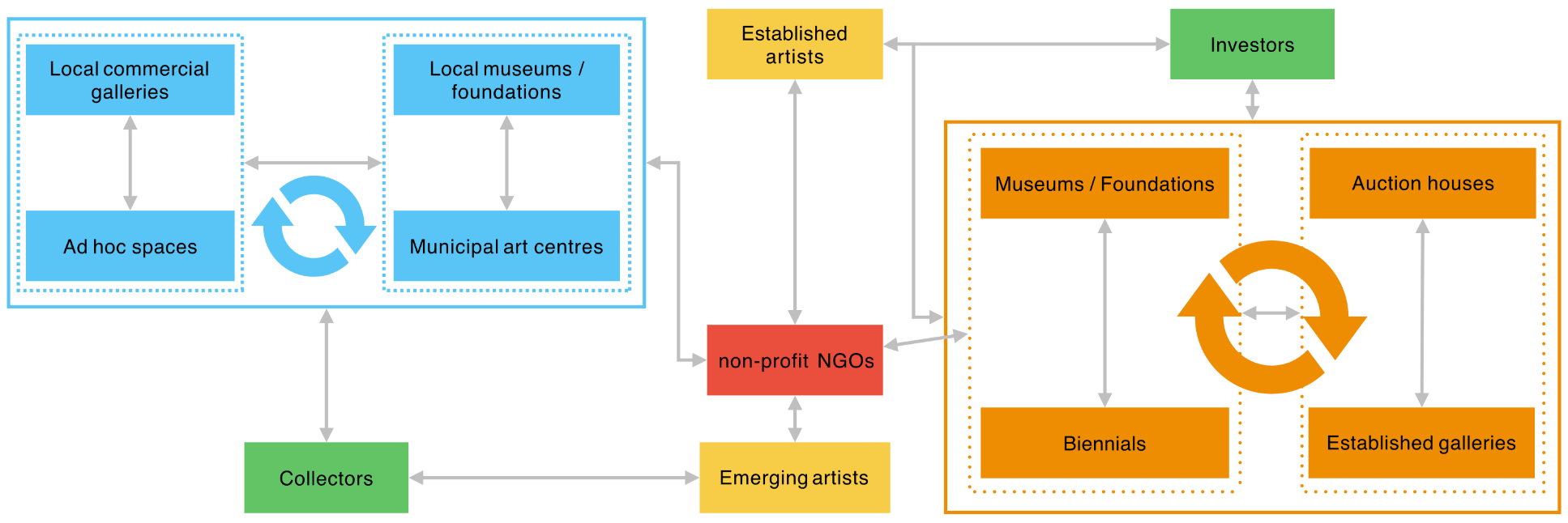
I acknowledge that my views of the arts scene are empirical and biased, and, for the sake of avoiding unnecessary complexities, I have excluded from these equilibriums, the important work done by universities, art curators, critics, and historians.
I also understand that not all NGOs are perceived equally, as not all have or want to seek opportunities for funding, networking, or research. Nevertheless, some act as a bridge between the local and the international worlds as they are the ones who are willing to take chances on supporting emerging artists but also include established artists in their projects. EU competitive funding programmes such as those of Creative Europe, Horizon, and COST, help NGOs with their networking, knowledge exchange, cross-national collaborations, and outreach. I strongly believe that all cultural NGOs, whether they are funded or not, are part of a very vibrant ecosystem, and in their totality, create knowledge and appreciation for the arts.
Abroad, I prefer to visit the spaces of small NGOs rather than major museums or foundations, as these spaces reflect the city’s living culture. Large institutions monetise, quantify and/or weaponise artistic production in a way that supports established political and cultural systems. In contrast, NGOs that provide horizontal, non-hierarchical methodologies, ethically engage with their communities, serving as hubs that encourage participation and collaboration. They create spaces for dialogue and interaction among diverse social groups, promoting cohesion and understanding.
Glossary
For clarity, and to avoid misinterpretation, I’m stipulating some terms and definitions as I mean them in this text and/or diagrams.
- Collectors
- Local collectors who buy artworks for decorating their spaces, and/or support the commercial gallery or an artist they know.
- Emerging artists
- Artists or collectives of any discipline, age, or stage of their careers who can not survive purely by their art.
- Established artists
- Artists or collectives of any discipline, or age who survive by the sales and/or presentation of their art.
- Fine arts
- The term is used as defined by the Cyprus Deputy Ministry of Culture funding programme. It includes, fine artists, media artists, video artists, performance artists, architects, graphic designers, product designers, ceramists, and photographers.
- Investors
- Major international art collectors and/or investors.
- NGOs
- Non Government Organisations. Registered non-profit, non-self-sustained, precarious cultural foundations, associations, and companies.
Background
In 2016, three years after the bail-in of the Cypriot banks3 which virtually emptied accounts worth millions of euros, leaving only the guaranteed €100,000 in the affected accounts, the Cultural Services of the MOEC changed the funding programme for NGOs. This made our existence even more precarious.
Although the previous program had its shortcomings—for instance, MOEC covered only 30% of project budgets, compelling NGOs to inflate cost estimates and pursue in-kind contributions that often confused those unfamiliar with local or sector-specific contexts—the new program requires matching funds that most NGOs have so far been unable to secure. This stems from Cypriot legislation, which grants tax exemptions only for donations directed to officially registered charities—a status most non-profit cultural NGOs do not have. In spite of a parliament approved, in our view, inadequate law published in the Cyprus Gazette 5070/1247 on 31 December 2025, the DMC has yet to propose the prerequisite terms to the ministerial council which will allow NGOs seek funding from elsewhere. As a result, founders and committee members are often forced to personally finance their organisations to meet co-funding obligations for approved projects. This places Cypriot cultural practitioners in a unique and challenging position within the EU as they are effectively the only ones required to pay out of pocket for the previllage to work in the cultural sector.
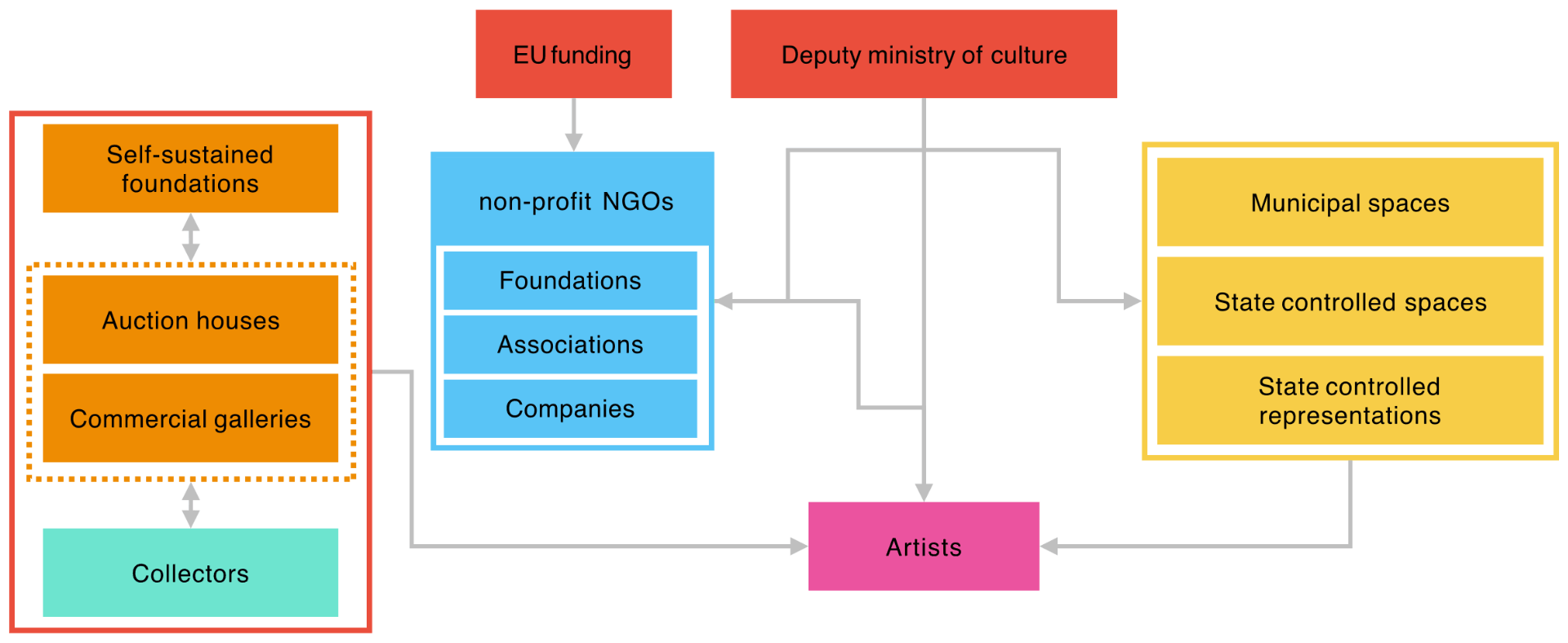
Between 2016 and 2020 many NGOs have individually booked appointments with the then Director of the Culture Department, Pavlos Parakskevas, to express their frustration with the programme. They were all welcomed with friendliness and humour but also with a bureaucratic denial to understand any of the problems. On Paraskevas’ retirement, and during the Covid-19 pandemic lockdowns, fine arts NGOs concluded that collective action was the only viable path toward meaningful change.
Initially, the inspiration came from David Graeber who wrote that
The ultimate, hidden truth of the world is that it is something that we make, and could just as easily make differently.4
Our first collective meeting took place during one of the curfew windows during the Covid-19 pandemic on October 7, 2021. It was graciously hosted by Achilleas Kentonis at the ARTos House in Nicosia and consisted of one representative from each of the 40 active NGOs at the time. The terms for the first, and subsequent meetings are clear:
- 1 person per NGO
- All NGOs can present their suggestions on improvements to the policy.
- Only suggestions without any objections are included.
- No majority votes.
- No concessions.
- Complete consensus. Focus on the issues we all agree.
- Abstentions are allowed.
- All correspondence is open for collective editing.
Our first, seven page, letter contained our suggestions and was co-edited and co-signed by 39 fine art NGOs with the 40th abstaining but writing their own letter to the Ministry stating that they are also supporting our content. Our second letter, co-edited and co-signed by 93 cultural NGOs from all disciplines, challenged the exclusion of culture from the Vision 2035 government sponsored study. Many other letters followed.
After the first meeting, we formed a working group consisting of Catherine Nikita, Efklides Papadopoulos, Christina Skarpari, Yiannis Toumazis, Argyro Toumazou and myself. On 4 July 2022, Yiannis Toumazis withdrew from the working group when he became the first Deputy Minister of the newly established Deputy Ministry of Culture (DMC). In 2025 Catherine Nikita withdrew, and few months later, Evagoras Vanezis joined the team. The working group does not make decisions, but rather coordinates efforts, and writes the drafts of the letters before opening them up for collective editing and discussion. In addition, it represents the fine arts NGOs in official meetings that were initially held at the Cultural Services of MOEC and, since 2022, at the DMC.
Early on we identified and distilled five major issues:
- The problem with policies is not only what they include, but also, what they leave out.
- The rules are made for us, without us.
- Regulations do not respond to the needs of the cultural ecosystem. Cultural policies are currently like ill fitting shoes.
- Policies and regulations prevent the professionalisation of cultural workers.
- The rules quantify work over the workers.
In addition, we identified the following:
- Using the shoestring budgets available to them, NGOs create a massive invisible foundation for the arts scene, and its audiences, as they initiate about 90% of the cultural events in Cyprus.
- NGOs help in augmenting artists’ income.
- Number of non-profit cultural organisations is increasing annually.
- Working conditions for cultural workers should be
improvedcreated. - Solving problems requires radical solutions.
Our strategy drew from Michel Foucault who stated that
Bringing out the conditions of acceptability of a system and following the lines of rupture that mark its emergence are two correlative operations.5
We set out to begin mapping the norms and rules that allow the system to appear stable. More significantly, however, we focused on identifying its fault lines, omissions, and contradictions that reveal moments of breakdown, where the system fails or shifts.
Our approach follows some simple ethical principles:
- Collectivity gives us a space in which to constitute new possibilities of participating in the democratic processes.
- Avoid the trap of our own subjectivities.
- Agonise, do not antagonise.
- Tactical pursuit towards bilaterally beneficial changes.
- Unmask power and confront it.
Numbers do not lie, people do
As dull as numbers may appear, they do matter when it comes to the sustainability of the non-profit cultural sector. Although statistics don’t lie in and of themselves, they can be misused, misconstrued, or misrepresented. The numbers are neutral; it’s how they are collected, analysed, and communicated that may create false impressions.
A chart showing the Government expenditure on culture found in the Eurostat website, circulated in the social media in 2020, boldly demonstrated that the Republic of Cyprus ranked second last in the EU regarding money allocated to culture. The Cyprus ranking in 2025, the latest year that statistical information is available, has not changed.
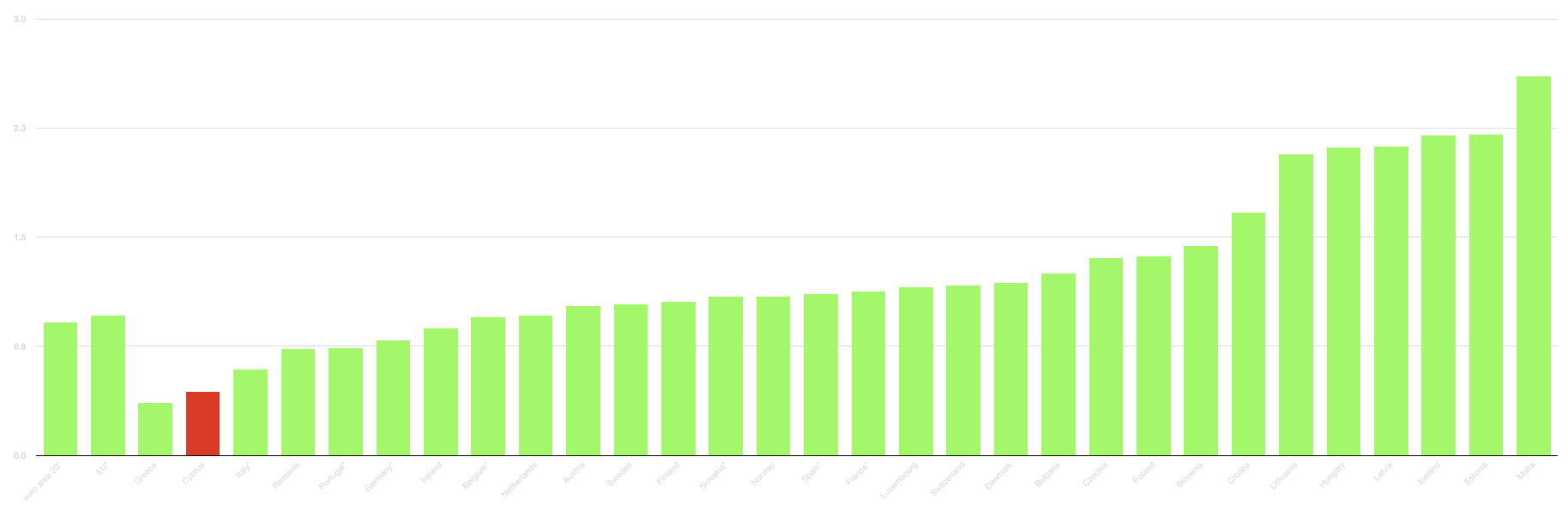
But what do these numbers mean? Cyprus government spends 0.439465% of its GDP on culture. This indeed appears like a very low percentage considering that the EU target is 1%, and Malta, one of the few EU countries smaller than Cyprus, ranks as number one by allocating 2.605121% of its GDP on culture!
Admittedly, for the past 6 years, the cultural sector had a fixation on the rounded 0.44 percentage, and none of us tried to translate that in actual euros. According to Eurostat , the Cyprus GDP is estimated to be €35,177,153,500 from which 0.439465% is allocated to culture which translates to €154,603,590. Interestingly only €8,900,000 is confirmed to be used for partially funding the whole of the non-profit cultural sector, libraries, cinema productions, monument commissions, and independent artists.
After my presentation in Larnaca, I was informed that the Deputy Ministry only receives about €50,000,000 annually which lets me wonder who is lying and who is telling the truth.
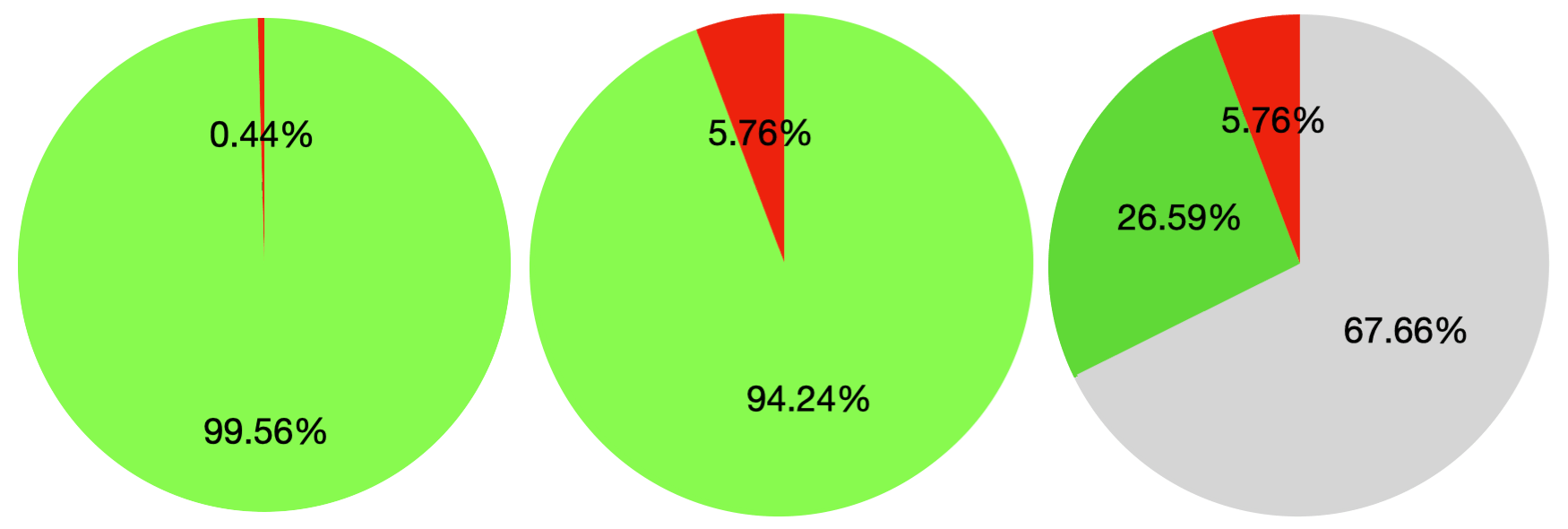
The possible interpretations we are left with are:
- The DMC receives more than is publicly declared.
- The government spends over two thirds (67.6566%) of the cultural budget on entertainment, or on other non-cultural projects.
- The funds of €50,000,000 allocated to the DMC are the only cultural funds.
Whatever the case might be, the entire truth is not available to us. I believe that the percentages to the GDP had very small variations since Cyprus joined the EU which means that the second and the third possibilities are probable, and that the long-standing accountability for this, spans many governments.
There is some evidence documented in mainstream news outlets6 reporting that the furniture of the cafeteria of the Cyprus parliament was purchased using part of the budget dedicated for “the acquisition of works of art or artistic event,” which supports the second possibility.
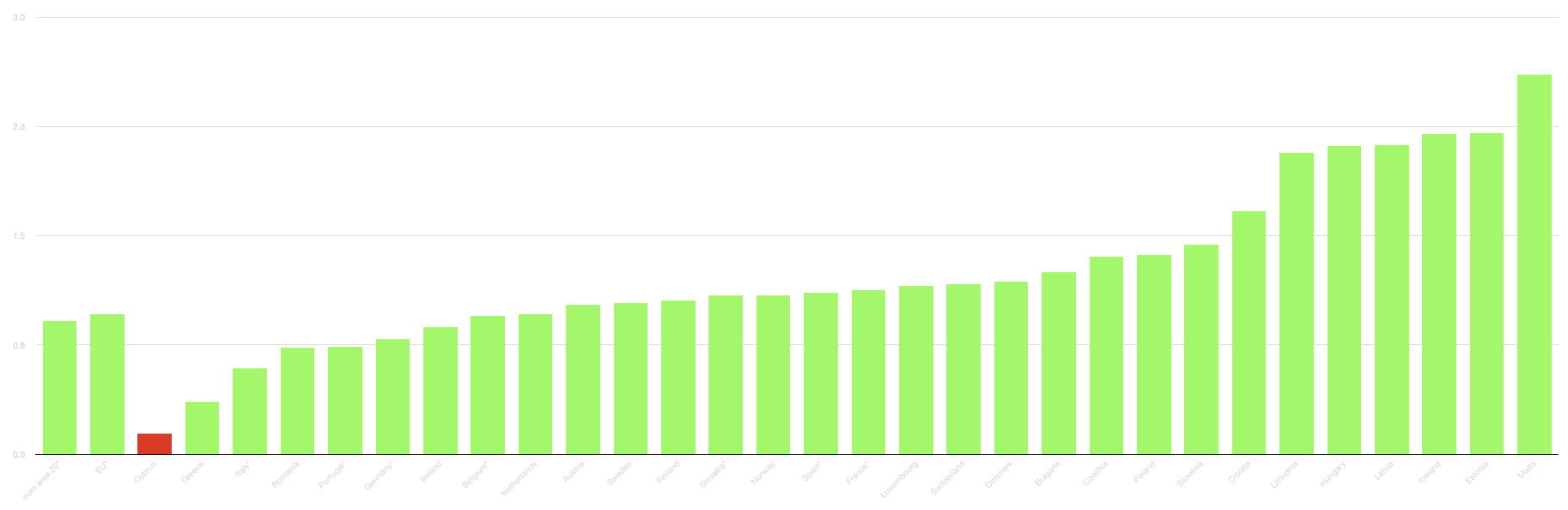
If the third possibility is correct, Cyprus ranks last in the government expenditure on culture in the EU, and the numbers supplied to Eurostat by our government are false. In this case, the actual percentage of Government expenditure on culture is 0.1421% which places Cyprus at the bottom end of the EU, with less than half of the 0.3594% that Greece allocates. This certainly reflects the realities of the cultural workers in Cyprus.
Beyond the low funding budgets available to cultural NGOs, the system defines what is considered rational, normal, legal, or real, while labelling the perspectives of the NGOs as irrational, emotional, or non-legal. The system as such, maintains a self-serving monopoly on truth and exploits our dependence by organising annual gladiatorial competitions for the funding it offers.
The system is opaque, hides behind the regulations it created, and denies organisations access to the official reality. This essentially denies the full ontological status of NGOs and their right to exist as full cultural subjects. By establishing a cultural dichotomy of us versus them, in which organisations are not viewed as autonomous capable legal entities, but as mere instruments to be controlled, NGOs and the cultural initiatives they foster are inevitably seen as expendable or marginal by the hegemonic order, as their function cannot easily align with profit-driven priorities..
Our options
The centralised funding system to which NGOs and artists are subjected has created many unforeseen problems. Every year sees the creation of additional cultural NGOs, most of which are artists run. In fine arts alone, my list of NGOs has expanded from 40 in 2020, to 56 in 2025, which amounts to a 40% increase in 5 years. This is objectively understandable because artists are competing for access to the funding, which has remained unchanged.
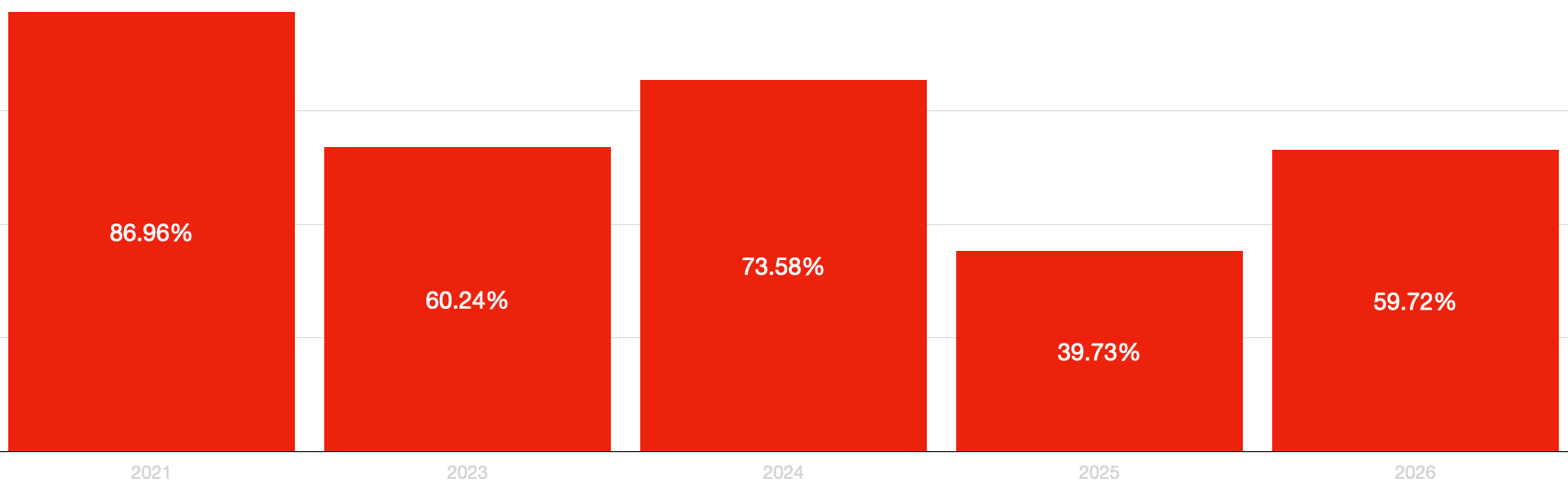
Moreover, it appears that regulatory changes introduced in 2024 by the DMC administration, under the leadership of Deputy Minister Vasiliki Kassianidou and the Director of the Contemporary Culture Department Ioanna Hadjicosti, were implemented under the guise of meritocracy, but effectively served to restrict access to funding. This has resulted in a significant reduction in the number of approved projects for fine arts NGOs. While 86.96% of submitted proposals were approved in 2021, this figure dropped to 39.73% in 2025, and then thankfully rose to 59.72% in 2026, the year of the Cyprus Presidency of the EU. The new funding programme awards 80% of the funding, with a maximum of €20,000, to all approved proposals until the the DMC allocated budget runs out. This programme is elitist, as it prevents NGOs for applying for large projects because they know they will not be able to meet the matching sums of €5,000.
Previously, there was a tiered funding programme where NGOs were awarded 70, 80, or 90% with each evaluation receiving a commensurate sum of €8,000, €12,000 and €20,000 of the funding which related to the percentage of their projects’ evaluations. Although the previous programme was also problematic, this option allowed for the inclusion of more projects.
Solving such problems requires radical solutions.
The options below have not been discussed in depth with most of the other NGOs but it is in my opinion, at this early stage, that unless we think radically, the situation will definitely worsen.
Option 1: Decentralisation
The first option is to remain as we are.
This, in my opinion, is no longer sustainable, although it has its own advantages. It gives NGOs their own agency, control, and freedom to select their own paths. It creates a polyphony in the arts scene which is also a disadvantage as we create cultural noise, to compete for the audiences’ attention.
Advantages
- Polyphony
- Failure/closure of any organisation has minimum affect
- Organisations have little say on policy unless they remain united
Disadvantages
- Precarity of organisations
- Cultural noise
Option 2: Merging of similar NGOs
The merging of similar NGOs may expand audiences, and make the resulting NGO stronger. For example, NGOs who specialise in exhibiting Cypriot contemporary artists could merge. Another example could be that an NGO that specialises in critically researched projects, could merge with another one that specialises in workshops for amateurs.

Advantages
- Sustainability of organisations
- Merge similar cultural organisations
- Strengthening organisations
- Merging of audiences
- Reduction in the number of organisations
- Slices of the funding pie may increase
Disadvantages
- Forging mergers may not work
- Erasure or disruption of individual NGOs histories
Option 3: Merging of complementary organisations
The merging of complementary organisations was inspired by the current war in Iran, where the killing of Grand Ayatollah Ali Hosseini Khamenei by the US had minimal implications for the country as a whole, since it favours decentralised, self-governing hierarchies at regional level. The strategic merging of complementary organisations should boost the sustainability of the cultural sector.

Advantages
- Sustainability of culture
- Strengthening of organisations
- Merging of audiences
- Slices of the funding pie may increase
- Self reliance
- Sustainability of organisations
Disadvantages
- Forging mergers may not work
- Erasure or disruption of individual NGOs histories
Conclusion
In 1988 Donna Haraway wrote that
[…] situated knowledges require that the object of knowledge be pictured as an actor and agent, not as a screen or a ground or a resource, never finally as slave to the master that closes off the dialectic in his unique agency and his authorship of ‘objective knowledge.’7
In agreement with Haraway, the working group acknowledges that each NGO has its own situated knowledge. It is only through the relational process the working group tries to maintain between NGOs that it can achieve the production of useful knowledge and a shared agency. In other words, we use our situated knowledges to create a community of NGOs, as the joining of partial views can form a collective position that fosters solidarity and critical inquiry. There is no single truth, but a mosaic of different points of view.
In Cyprus, quantifiable work is valued more than the precarity of the people who do it, and every year more bureaucratic responsibilities are added to the funding programmes that NGOs often struggle to fulfil. NGOs, and the cultural workers within them, are treated as non-institutional actors, and the system imposes upon us a particular function and destiny which forces us to an elective submission to power in order to survive. For the past six years we have been asking to participate in the meta-institutional operations of the drafting of the policies in order to include essential and long overdue, mutually beneficial, updates, and changes.
Our work is not seeking to eliminate institutions, as this would lead to their replacement with other institutions, but rather, to create the legal and funding frameworks for our autonomy, and reduce our dependency on a system that exerts its control upon us, and as such preventing NGOs from reaching their potentialities. More precisely, our work is not extra- or anti-institutional, but aims to create transparent frameworks and conditions on how we can gain recognition as para-institutional, infrastructural, autonomous, and beneficial organisations. Our objective is to open a sustainable, non-profit, cultural space of contingency in which new practices, discourses, networks, and projects can emerge freely, and funded properly.
To date we have failed to achieve most of our aims but we will “Try again. Fail again. Fail better”8 as “failure is more beautiful than success.”9
Notes
- Dark Matter: Art and Politics in the Age of Enterprise Culture, by Gregory Sholette, published by Pluto Press in 2010, offers a more scholarly and substantial analysis of the politics of visibility in the art world.
- Max Haiven. Art after Money, Money after Art: Creative Strategies Against Financialization, Pluto Press, 2018.
- See en.wikipedia.org/wiki… %932013_Cypriot_financial_crisis
- David Graeber. The Utopia of Rules: On Technology, Stupidity, and the Secret Joys of Bureaucracy, Melville House, 2015.
- Foucault, cited in Reiner Schürmann, “On Constituting Oneself as an Anarchistic Subject,” in Tomorrow the Manifold: Essays on Foucault, Anarchy and the Singularization to Come, ed. Malte Fabian Rauch and Nicolas Schneider, Diaphanes, 2019.
- Juliet Michael. “Ιδού τα πανάκριβα έπιπλα και τα «έργα τέχνης» στην καντίνα της Βουλής” (tr. “Here are the exorbitantly expensive furniture and the ‘works of art’ in the Parliament cafeteria”), Omega Live, 3 June 2025. omegalive.com.cy/kypros… -binteo/ . Accessed on 22 June 2026.
- Donna Haraway. “Situated Knowledges: The Science Question in Feminism and the Privilege of Partial Perspective,” originally published in Feminist Studies, Volume 14, Issue 3, 1988.
- Samuel Beckett. “Worstward Ho,” published in Nohow On, John Calder, 1989.
- John Fante.Ask the Dust, Stackpole Sons, 1939.
Yiannis Colakides is an architect, cultural organiser, active curator and editor working in the intersection of arts, society, bio-politics, and technology. He co-founded the non-profit NGO NeMe with Helene Black.
Among other books, he co-edited State Machines: Reflections and Actions at the Edge of Digital Citizenship, Finance, and Art (Institute of Network Cultures, 2019) with Marc Garrett & Inte Gloerich; Frankenstein Reanimated: Creation & Technology in the 21st Century (Torque editions, 2022) with Marc Garrett; and A sea change: Political, Natural, and Cultural Ecologies of the Mediterranean (Quo Artis, 2024) with Tatiana Kourochkina, Helena Pérez, & Victoria Sacco.