Subversive, Investigative, and Open Source Practices
https://www.neme.org/blog/siosp
Call for Participants
2-day training school (18-19 25-26 May 2026)
Hosted by the University of Galway
Calling artists, agents, shape shifters, spooks and tricksters: those who work in the spaces between certainty and possibility, who thrive in ambiguity, on the ground and underground, challenging and subverting systems of power using any tools and techniques available to them. Join us for two days in Galway for creative discussion, exploration and imagination.
Subversive artistic practices have a long history. The internet and digital platforms have provided opportunities not only to oppose hegemonic politics or culture directly, but also to ‘sidestep’ or ‘hijack’ institutional power, allowing artists to operate within their own rules.
Artistic practice often spans or blurs ways of working, straddling disciplines that have conflicting authorities, histories, or modes of representation. These practices may incorporate, work with, and cross over with activist methods, but expand and move between different modes of engagement and representation. In practice, such methods can be humorous, investigatory, and non-conforming, sometimes flawed or failing. They sidestep, dodge, flip-back and are not troubled by their limitations or imperfections. Often carried out away from or at a distance from the structures of academic research, these works are modest, low or no-budget, and self-directed. Their playful undercover-ness is embedded in art practices that may trouble or challenge authority, power structures, institutions, or established hierarchies. They are, according to Lucy Lippard, “[b]ased in subversion on the one hand, and empowerment on the other, [… and operate] both within and beyond the beleaguered fortress that is high culture.”1
This way of working also challenges how knowledge itself is produced and legitimised. Donna Haraway proposes that “situated knowledges require that the object of knowledge be pictured as an actor and agent, not as a screen or a ground or a resource, never finally as slave to the master that closes off the dialectic in his unique agency and his authorship of ‘objective knowledge.’”2 This reframing frees up knowledge to be ‘fleet of foot’ or fluid, suggesting opportunities for dalliance or diversion as knowledge evolves. It releases the researcher and artist from dominant, omnipresent or overbearing authorship and creates a space for divergence, foregrounding the minority or lone voice.
What is the training school?
For this COST funded training school we want to hear from radical practitioners, about idiosyncrasies, technologies, the blurs, celebrate the vague and iterative and promote spaces of vulnerability and sharing. We hope that the training school will demonstrate the potential of arts research and practice, demonstrate the possibility of working across disciplines and contexts and better understand the ways that artists navigate structures that often work in opposition to them.
Ten applicants will be selected for this 2-day training school that seeks contributions from academics, artists, creative technologists, activists, theorists, and researchers who have developed or are developing ideas, frameworks, and/or projects. We especially encourage Young Researchers and Innovators under the age of 40, and individuals affiliated to COST Inclusiveness Target Countries (pdf) to apply. We will consider gender balance and geographical diversity in our selection.
What is expected
Each of the 10 selected speakers will be expected to attend the full two day training school on the 25th and 26th of May 2026 (arrival date, 24th of May; departure date, 27th of May), deliver a 30’ talk, and respond to a Q&A session.
Important dates
- Applications deadline: 12 April 2026.
- Selection notification: 24 April 2026.
- Arrival date of speakers: 24 May 2026.
- Training school:
18-1925-26 May 2026. - Departure date of speakers: 27 May 2026.
Who can apply?
Practitioners/researchers of any nationality or place of residency affiliated with an academic or other legal entity3 in one of these countries: Albania, Algeria, Armenia, Austria, Azerbaijan, Belgium, Bosnia and Herzegovina, Bulgaria, Croatia, Cyprus, Czech Republic, Denmark, Egypt, Estonia, the Faroe Islands, Finland, France, Georgia, Germany, Greece, Hungary,4 Iceland, Ireland, Italy, Israel, Jordan, Kosovo, Latvia, Lebanon, Libya, Lithuania, Luxembourg, Malta, Republic of Moldova, Montenegro, Morocco, Republic of North Macedonia, Netherlands, Norway, Palestine, Poland, Portugal, Romania, Serbia, Slovakia, Slovenia, South Africa, Spain, Sweden, Switzerland, Syria, Tunisia, Turkey, Ukraine (government controlled territories), United Kingdom, as well as in one of the EU Member States Outermost Regions (French Guiana, Guadeloupe, Martinique, Mayotte, Reunion Island and Saint-Martin, Azores and Madeira, and the Canary Islands). (pdf )
We especially encourage Young Researchers and Innovators5 and individuals affiliated to COST Inclusiveness Target Countries to apply. We will consider gender balance and geographical diversity in our selection.
Long-distance participants shall have their travel expenses reimbursed (up to €500 for long-distance travel — unless otherwise arranged with the organisers — and up to €217 per day, for 3 nights, to cover accommodation and subsistence) according to COST travel reimbursement rules. For more information, please see A1-3.1 according to COST Travel reimbursement Rules (A1-3.1) (pdf) .
This training school is part of the COST (European Cooperation in Science and Technology)-funded project: TOOLKIT OF CARE (TOC), CA21102.
About TOOLKIT OF CARE
TOOLKIT OF CARE (TOC) is an international project led by an interdisciplinary group of creative practitioners, academics, researchers, and arts organisations that specialise in creative technologies and have considerable experience in the production and dissemination of this kind of knowledge across Europe and internationally, who have come together to form a “critical network of care.” The network collaborates to share their collective expertise and technical knowledge employed in creative ways to develop knowledge and methodologies of care. The main aim is to produce a well formulated and integrated TOOLKIT OF CARE comprising articles, prototypes, audiovisual documentation, technical manuals, theoretical analysis, and data. It will act as a model of how to successfully share knowledge and expertise across different geographical regions and social groups.
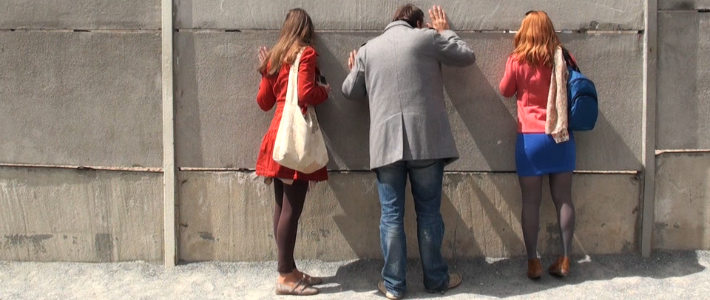
Image credit
Rose Butler, Film still, Lines of Resistance
Application
To Apply, upload a 250-word abstract of your presentation proposal, a short biography (max. 100 words) and a CV in one pdf using the form below. Before posting your submission we recommend compressing the pdf document on ilovepdf.com/compress_pdf . Expired!
Committee
This COST funded TS for TOC was conceived and developed by Rose Butler (Sheffield Hallam University, UK ), Anthea Caddy (Sonic Acts / University of New South Wales), Yiannis Colakides (NeMe), and Paul O’ Neill (University of Galway ) who will also be part of the selection committee.
Notes
- Lucy R. Lippard, “Trojan Horses: Activist Art and Power,” in Brian Wallis (ed.) Art after Modernism: Rethinking Representation. New Museum of Contemporary Art, 1984, 341–359, 341.
- Donna Haraway. “Situated Knowledges: The Science Question in Feminism and the Privilege of Partial Perspective.” Feminist Studies, 14 (3) 575-599. Feminist Studies, Inc. 1988.
- A non-exhaustive list of examples of such an affiliation: work contract, enrolment in a PhD or Post-Doctoral programme, voluntary service in a NGO, and Emeritus professorship.
- Following the CSO decision of the 16 October 2023, considering the new guidance from the European Commission, as of 1 November 2023 until further notice, individuals from universities maintained by public interest trusts established under Hungarian Act IX of 2021 and concerned by the Council Implementation Decision 2022/2056 (see entities listed in Annex I of the Hungarian Act IX of 2021 ) are allowed to participate in COST activities without receiving financial support from the COST Association (either grants or via reimbursements). Individuals from the flagged institutions can apply to get funded via the Guarantee Fund established by the Hungarian government. The Hungarian Act IX of 2021 is available in Hungarian. You can use one of the frequent translation web-based tools in order to get an English translation. A non-exhaustive list of the affected Hungarian legal entities is available on cost.eu/uploads/2023… -2056.pdf .
- A researcher or innovator under the age of 40.